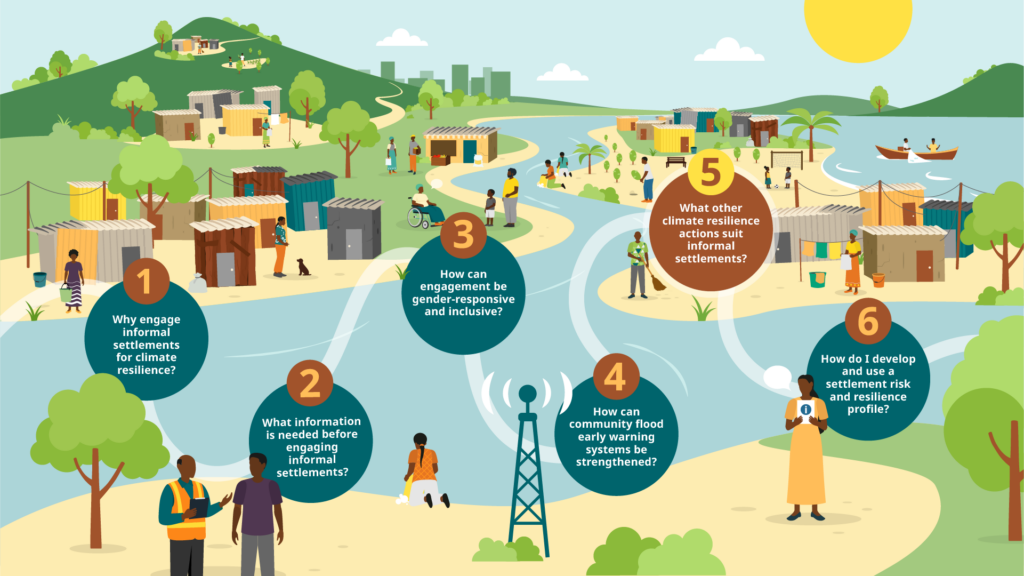
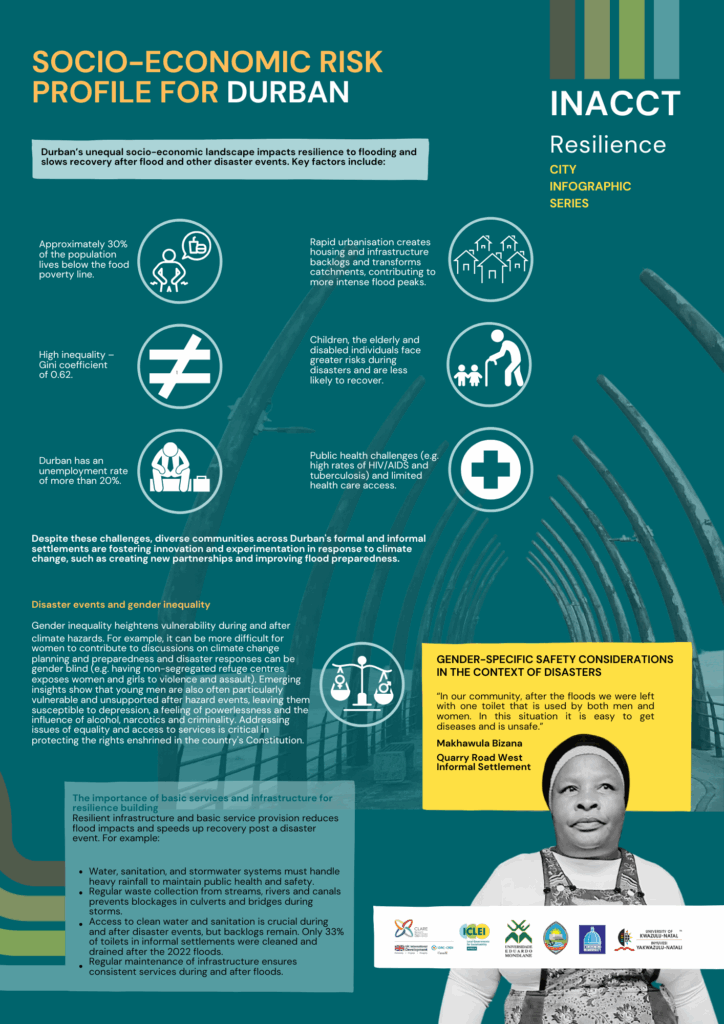
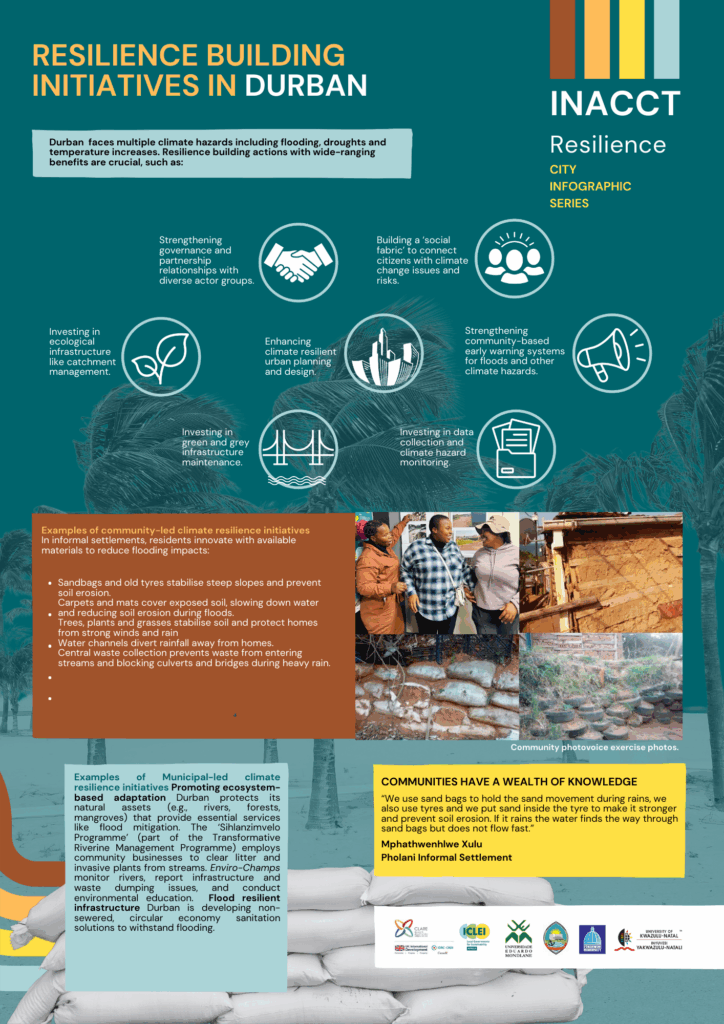
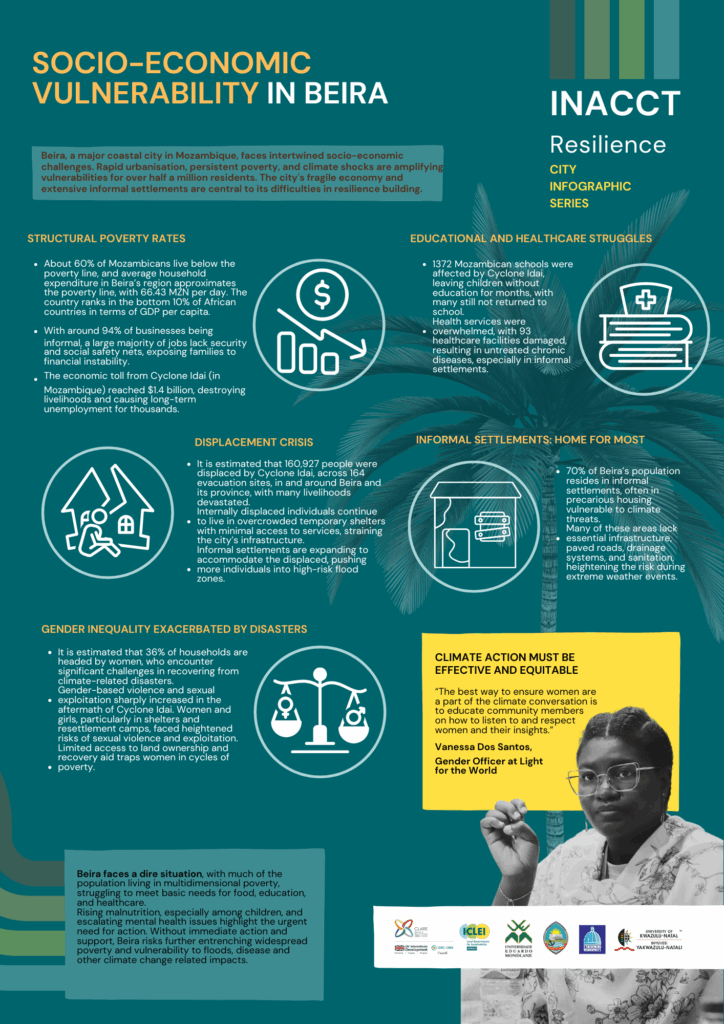
What other responses (pre-, during- and post-disaster) might be relevant in informal settlements to build climate resilience?
Although early warning systems play a critical role in alerting communities to an imminent flood event, a number of other responses before, during and after a flood event are equally important in reducing risks and potential loss of life and belongings. These include pre-flood risk mapping and response planning at a community level, building capacity and trust to understand and act appropriately
on the warnings received, and equipping communities with the physical materials that they need to raise the alarm and mobilise the broader community.
As part of the INACCT Resilience Project, work has focused on building capacity through the development of CBFEWS training materials and information posters. Emergency toolkit items (e.g. danger tape, whistles, high visibility vests and loudhailers) have also been prioritised, and in some cases provided, in relevant communities. Risk mapping has also helped to build an understanding of the nature of the flood risk in different settlements, and the specific actions needed to minimise impacts.
TBC
Durban’s CBFEWS
This document consolidates Durban’s existing CBFEWS experience in the Palmiet Catchment and shares reflections on what this experience means for upscaling CBFEWS in other locations
This document shares the approach Durban adopted to test CBFEWS upscaling in additional settlements in Durban and documents the outcomes and learnings.
Learnings and recommendations for upscaling CBFEWS
This document consolidates the CBFEWS experiences to date across Durban and Beira, and provides practical guidelines and recommendations on how to upscale CBFEWS in other areas.
CLARE is a £110m, UK-Canada framework research programme on Climate Adaptation and Resilience, aiming to enable socially inclusive and sustainable action to build resilience to climate change and natural hazards. CLARE is an initiative jointly designed, funded and run by the UK Foreign Commonwealth and Development Office and Canada’s International Development Research Centre. CLARE is primarily funded by UK aid from the UK government, along with the International Development Research Centre, Canada.